
Parmer Projected Versus Actual Release
A projected release date is a calculation, not proof that someone has left custody. TDCJ uses that exact field name for a state prisoner. Its meaning depends on the offense date, release eligibility, Board action, and sentence. An actual release date records the event after it occurs. For Parmer County Jail, the sheriff's release record is the direct source for the physical end of local custody.
A pretrial detainee usually has no fixed release date. Release can depend on bond, a court order, dismissal, plea, or transfer. A sentenced county inmate may have an expected completion date, but local credit and any other hold must be confirmed with the jail and court. A sentenced state prisoner follows TDCJ calculations.
Find a Parmer Projected Release Date
First identify the custodian. The Parmer current-inmate portal is a live county roster and admissions tool. It does not show a release-date field. TDCJ's official offender search is the correct state-prison channel. Federal prison has a separate BOP locator.
- Confirm the full name, date of birth, and booking, SID, or TDCJ number.
- For Parmer County Jail, call 806-481-3303 and identify the court and case.
- Read the judgment for sentence length, credit, concurrent or consecutive terms, and findings.
- For TDCJ custody, open the matching offender record and record the exact Projected Release Date and parole fields.
- Check for another agency's detainer, pending case, or transfer. Recheck near the date.
The Parmer released-inmate search helps when the person has already left the county roster. A negative roster result alone cannot show whether release, TDCJ transfer, another county, ICE, or federal custody followed.
Texas Good Time for Parmer Releases
Texas Government Code Chapter 498 governs TDCJ good conduct time. Section 498.003 addresses classification and accrual. The credit is a privilege, not a vested right, and applies to parole or mandatory-supervision calculations only where law permits. It does not shorten the sentence written in the judgment. Section 498.004 permits forfeiture or suspension for misconduct under law and policy.
Texas has no blanket rule that every state prisoner serves 85 percent. For specified aggravated cases, Government Code section 508.145(d) generally uses actual calendar time equal to one-half of the sentence or thirty years, whichever is less, with minimums and special rules. Eligibility is not release. The parole panel may deny it.
The conviction and affirmative findings matter. Current law uses Code of Criminal Procedure article 42A.054 for specified offenses and deadly-weapon findings, once often called "3g." Do not classify a case from an arrest label alone. Read the final judgment.
Why Parmer Release Dates Change
A projection can move because the legal and custody inputs move. Even when the date stays the same, release into the community can be blocked by a receiving authority.
| Factor | Possible effect |
|---|---|
| Good-time classification or forfeiture | Changes credit used in an eligible TDCJ calculation. |
| Parole panel vote | May approve, deny, set conditions, or set later review. |
| Mandatory-supervision exclusion | Can make the projected field operate as discharge rather than earlier release. |
| New or corrected judgment | Changes sentence data, credit, or concurrent/consecutive structure. |
| Detainer or warrant | Can cause transfer to another authority instead of community release. |
| Required program or release plan | May delay processing when a condition remains incomplete. |
Offense date also changes the TDCJ field's meaning. For an eligible offense before September 1, 1996, TDCJ says mandatory release occurs on the projected date if parole has not occurred. For later eligible offenses, the Board has discretion. Ineligible cases and denied mandatory supervision can make the projected date the discharge date.
Parmer Has No 85 Percent Rule
The frequent "85 percent" claim does not describe Texas law as a whole. It may come from federal rules or another state. A Parmer County case must be calculated from its own judgment, offense date, statute, credit, and TDCJ status. Applying a flat percentage can produce a false travel date by months or years.
Parole eligibility, mandatory supervision, and discharge are separate milestones. Eligibility merely opens review. Mandatory supervision depends on the statute and, for many later offenses, Board discretion. Discharge ends the sentence or supervision stated by the controlling record.
The safest estimate uses the TDCJ field as displayed and documents the lookup date. If a number from a private calculator conflicts with TDCJ, ask TDCJ or counsel handling the case rather than averaging the two.
TDCJ's Parmer Release-Date Definition
TDCJ publishes a precise Projected Release Date definition. That definition is essential because the same label can point to mandatory supervision or discharge based on the person's law and Board result.
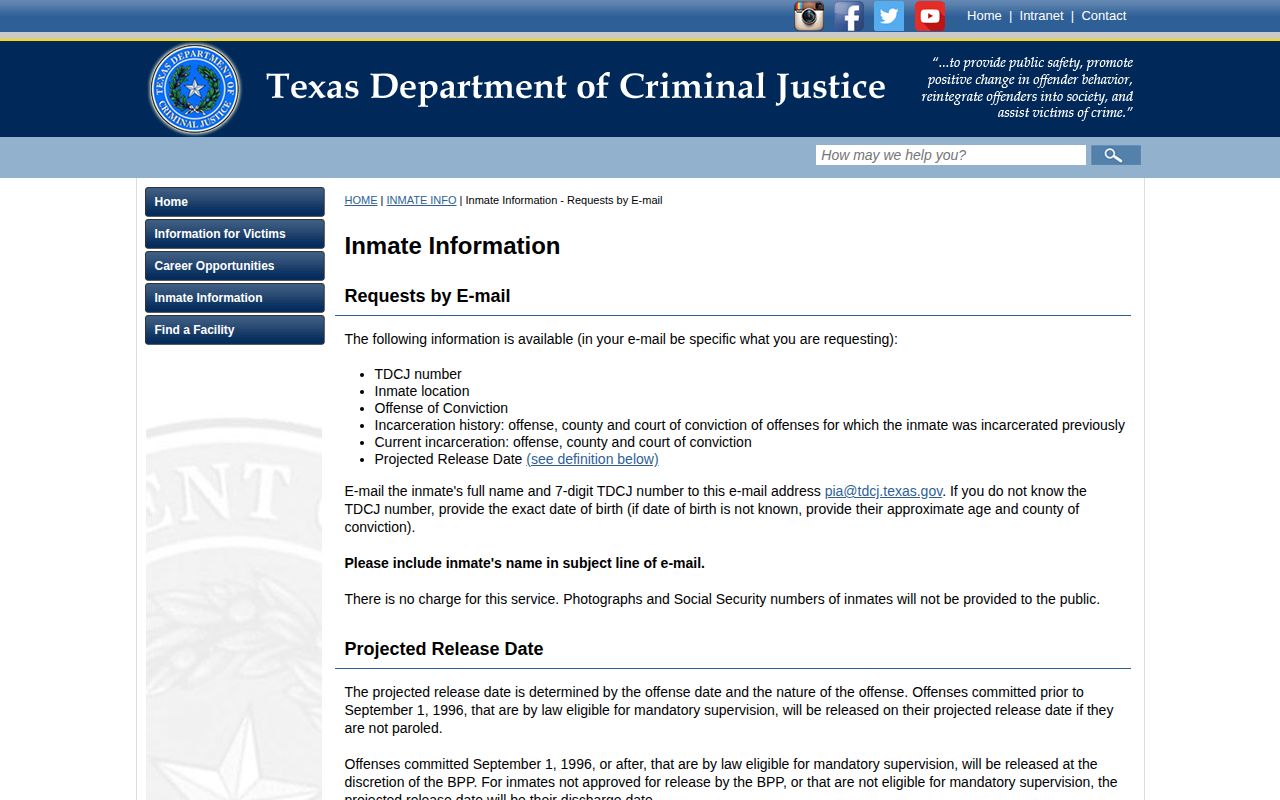
The captured explanation supports the field meaning. It does not replace the live offender record for a named person.
When TDCJ Releases Parmer Prisoners
TDCJ says releases from its facilities occur between 8:00 a.m. and 5:00 p.m., Monday through Friday, excluding holidays. Scheduled releases can change, and families are encouraged to call the unit before travel. Those are state-facility practices. They are not Parmer County Jail release hours.
A state-jail inmate may leave the assigned unit or receive a bus voucher to the county of residence and does not receive release money under Government Code section 501.015(b). Qualifying prison releases can involve civilian clothes, transport, trust-fund funds, and a gate check. The exact path depends on the release type.
That distinction matters for planning a pickup from Farwell. Confirm the actual unit, release location, and date. A Parmer connection does not mean a TDCJ prisoner exits at the county jail.
Confirm a Parmer Release Date
Recheck the official source close to the projected day. For TDCJ, use the offender search and status line. For Parmer County Jail, call the sheriff and request the booking and release record. The record should name the actual date, disposition, authority, and transfer destination when relevant.
Use the VINE Inmate Check to set an IVSS alert for a specific state or county record. An alert helps with timing but does not override a later hold or court order. Preserve the notice, then confirm it.
If the person enters federal prison, the BOP Release Date is a different calculation. A future BOP date is projected; a past date with no facility or a Released/Not in BOP Custody status marks the end of BOP custody, not necessarily the end of all custody or supervision.
Parmer Jail Date Calculations Differ
County-jail good time is separate from TDCJ's state calculation. The researched Parmer sources do not publish a local formula, calculator, weekend-release rule, or fixed processing schedule. Do not apply Chapter 498 credits to a Parmer jail sentence or infer a release hour from TDCJ practice.
Ask the jail and sentencing court for the controlling facts: sentence start, credit for time served, concurrent or consecutive terms, local credit actually awarded, and any hold. A bond case is not a sentence calculation. A transfer to TDCJ or another county ends one local custody stage but does not necessarily place the person in the community.
The sheriff's commissary guidance distinguishes a person who is released from one transported to another facility. That local language is a key date-checking clue. Request the disposition and destination rather than asking only whether the person "left."
Parole Dates Are Not Promises
Texas parole panels review files without a formal individual public hearing. A favorable vote may still require a release plan, program, or other processing. Use the official review result and vote code, then call the release-processing line after approval. Do not turn an eligibility date or review date into an expected gate date.
Administrative revocation is another distinct event. A person already released on parole can face a preliminary, revocation, or mitigation hearing after an alleged violation. Outcomes include continued supervision, sanctions, intermediate placement, or return to prison. A warrant or revocation process can therefore disrupt an earlier date without changing what the old lookup showed at the time.
Record when each status was checked. Date-stamped notes make it clear whether a projection was current before or after a Board action, judgment correction, or detainer.
Request Parmer Release-Date Records
When the local roster cannot answer the question, use the PCSO open-records form. Identify the person and ask for the booking and release record, including admission time, actual release time, disposition, releasing authority, and transfer destination. Add the case or booking number and approximate arrest date when known. The form requires picture identification.
The form states that requests may take up to ten business days. It allows pickup, mail, fax, or email and warns that reproduction, labor, overhead, and material charges may apply. If the agency seeks an Attorney General ruling on an exception, the form warns of added time. None of those statements guarantees access to each requested field.
For a state record, TDCJ's Office of General Counsel accepts online, email, mail, and hand-delivered Public Information Act requests. A narrow request can seek the release certificate, actual date, release type and location, or an existing record explaining the operative calculation. Provide the TDCJ or SID number and a date range if known.
The court file completes the picture. It can show credit for time served, sentence structure, a deadly-weapon finding, dismissal, bond, or a later order. The jail or TDCJ record supplies the physical custody event. Read both before declaring a final date.
Keep the exact search date with every projection. A saved value without its lookup date can conceal a later recalculation, new order, or changed hold.
Identity errors can also distort a release-date search. Compare the full name, birth date, TDCJ or SID number, age, and sentence record before saving a date. If two people share a name, do not choose the result with the most plausible county or release estimate. Return to the booking record or court case for the identifier.
A transfer date is not an actual community-release date. Parmer County Jail may transfer a person to TDCJ, another county, a federal authority, or immigration custody. TDCJ can likewise release someone to another legal hold. Ask the releasing agency to name the destination, then use the receiving agency's record to continue the timeline.
For personal planning, allow for processing and transportation after the legal date. The official date answers when custody status changes in the agency record. It does not guarantee a precise pickup time, route, bus arrival, or reporting appointment. Those facts must come from the unit and release papers.