
Parmer Parole and Probation
Parole and probation can both place a person under rules in the community, but they begin in different places. Parole follows release from a Texas prison sentence and remains part of that sentence. The Texas Department of Criminal Justice Parole Division supervises it. Probation, formally called community supervision in Texas, is ordered by a court and may let a person serve all or part of a sentence outside jail or prison. Parmer County Community Supervision and Corrections Department handles the local probation channel.
The distinction controls where to verify a released person. A Parmer County Jail departure does not by itself create parole. Someone may leave on bond with a case pending, finish a short jail term, transfer to TDCJ, or start court-ordered probation. Read the release disposition and court order first. For a person leaving state prison, use the TDCJ offender and parole systems. For a local probation order, use the court file and Parmer County CSCD.
| Question | Parole | Probation |
|---|---|---|
| Who orders it? | Texas parole authorities after prison | County or district court |
| Who supervises it? | TDCJ Parole Division | Parmer County CSCD |
| Best proof | TDCJ status, release certificate, parole record | Judgment, docket, probation order |
| How it ends | Discharge or other formal end of parole | Court-ordered completion, discharge, or termination |
- Parole
- Conditional release from prison while the sentence remains active.
- Probation
- Court-ordered community supervision, often instead of confinement.
- Discharge
- The formal end of custody or supervision, not merely a move between offices.
- Absconder
- A supervised person alleged to have stopped reporting or left supervision without approval.
Verify Parmer Post-Release Supervision
Start with identity and custody history. Similar names are common, and the county roster does not show a full supervision history. A TDCJ number or State Identification number is stronger than a name alone. The official TDCJ Inmate Search and Parole Review Information can show state-custody and parole-review data. It does not replace the local court file for probation.
- Confirm the full name, date of birth, and TDCJ or SID number when known.
- Search TDCJ and read the status, release information, and parole-review fields exactly as displayed.
- Use the TDCJ county-to-office directory to map Parmer County parole questions to Plainview.
- For probation, identify the sentencing court and ask Parmer County CSCD to verify the correct reporting channel.
- Compare the result with the judgment, release certificate, or discharge record. Do not infer supervision from a missing jail-roster name.
TDCJ also provides an automated status line at 844-512-0461. The line can help with parole-review status, but an approval vote is not the same as physical release. After approval, release processing has a separate status line at 512-406-5202. A parole panel may impose a future review date or conditions that must be met before release. Record the vote code and date without translating them into a promise.
Parmer Supervision Office Routes
Parmer County sits in two supervision routes. The Parmer County Community Supervision and Corrections Department is the local probation contact. TDCJ's official directory assigns Parmer County parole matters to the Plainview District Parole Office. Neither office is the Parmer County Jail, and neither should be used as a substitute for a jail release record.
Parmer County CSCDP.O. Box 487
Farwell, TX 79325
Phone: 806-481-9454
Fax: 806-481-9137 TDCJ Plainview District Parole Office
1001 North Interstate 27, Suite 232
Plainview, TX 79072
Phone: 806-293-5989
The county page lists a mailing address but no public walk-in schedule. Call before visiting. The Plainview office is a regional assignment, so its location does not mean every supervised person must report there in person. Reporting directions come from the assigned officer and release documents.
The official local supervision page is shown below. It confirms the county probation channel and keeps local court supervision distinct from state parole.
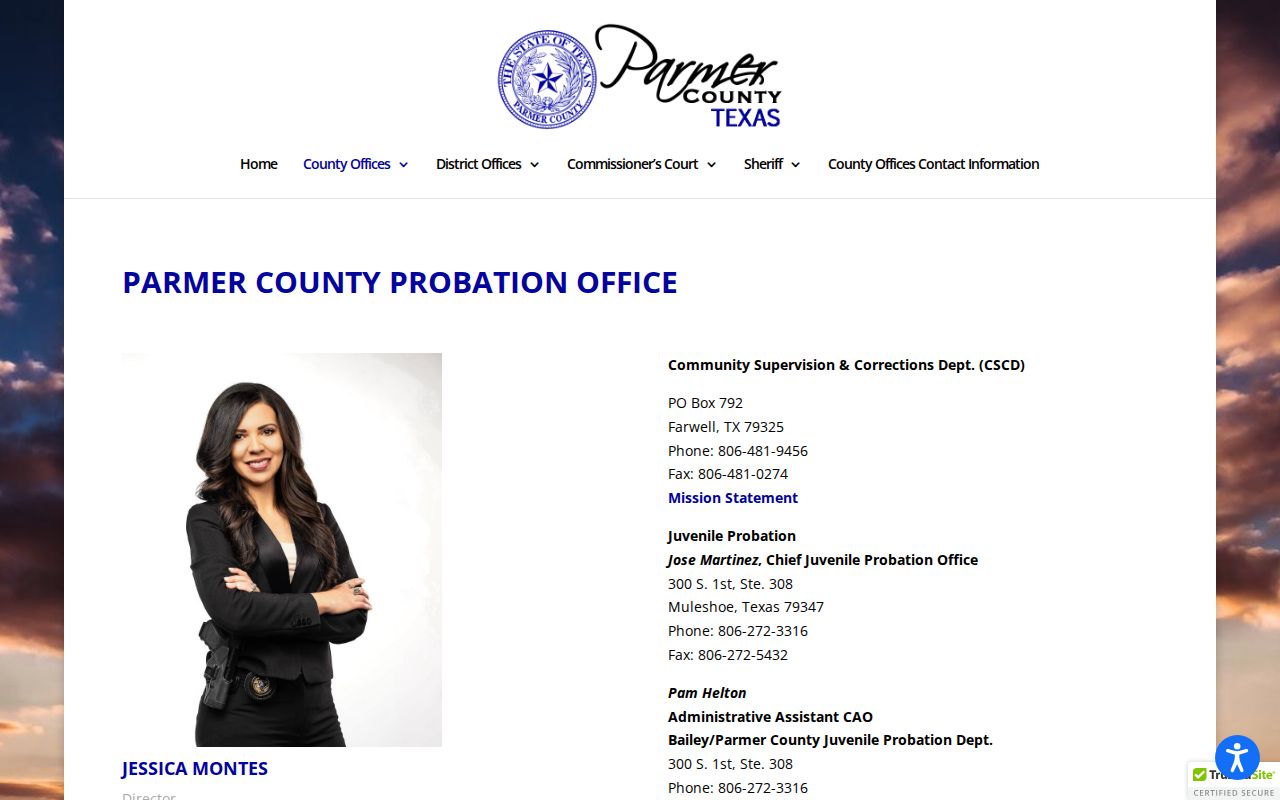
Use that office for local community-supervision routing, then use the sentencing court for the controlling order.
Parmer Supervision Status Changes
Conditions vary by the order and the case. Common terms may require reporting, approved travel, fees, classes, treatment, testing, or limits on contact. Only the signed order and later modifications state the actual rules. A public status entry should not be expanded into conditions that are not shown.
A missed report does not let an outside observer declare that a person has absconded. That label reflects an agency determination. A violation allegation can lead to a warrant, added conditions, an administrative parole-revocation process, or a court hearing in a probation case. It does not automatically cancel the original release. The person may remain on supervision while the allegation is resolved.
Texas parole revocation differs from the file review used for initial parole. The Board revocation process may include preliminary, revocation, or mitigation hearings. Outcomes can range from continued supervision to sanctions or return to prison. Local probation violations go back through the court that ordered community supervision. Court dockets and the supervising office are the sound sources for case-specific status.
Why Parmer Parole Routes Plainview
Parmer County has no TDCJ district parole office listed within the county. The statewide directory maps it to Plainview. That regional setup is easy to miss because probation has a local Farwell contact. The agency, not the nearest street address, determines which channel applies.
The official parole-office mapping provides the source for that assignment. The captured state page appears below.
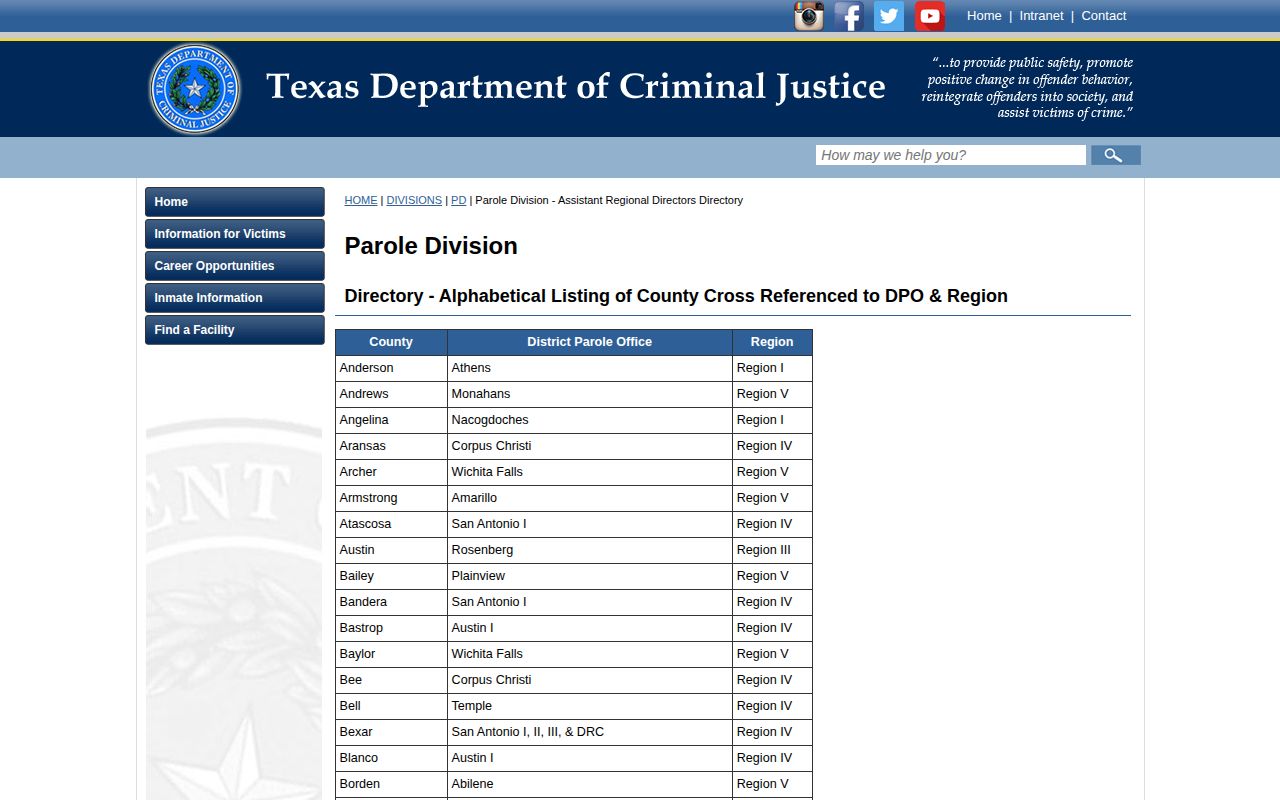
Always confirm the active officer and reporting method from the person's paperwork. Office territories and individual assignments can change.
Parmer Parole Review Results
Texas does not hold a formal public hearing for each parole or mandatory-supervision review. Panel members review and vote on the file individually. There is no courthouse-style Parmer County parole hearing calendar to attend. The Board's public meetings concern policy and agency business, not a list of individual release hearings.
For a specific person, use the TDCJ search and the official parole-review results route. Vote codes require care. Approval may include conditions and processing, while denial may set a later review. Eligibility means the file can be considered; it does not guarantee release.
The Board's review page documents the lack of formal individual hearings. This distinction prevents a missed calendar search from being mistaken for a missed decision.
How Parmer Supervision Ends
Supervision ends through a formal act, not silence in an online search. Parole can end through discharge, sentence expiration, revocation, or another official change. Probation may end after successful completion, early termination by the court, revocation, or another court order. Ask for the record that names the event and effective date.
A TDCJ discharge record addresses state supervision. A local probation discharge or termination should appear through CSCD and the sentencing court. The Parmer County released-inmate search supplies the broader custody trail when it is unclear whether the person left jail, transferred, or began supervision.
Texas notification tools can alert eligible registrants to some custody and supervision events. They are notice systems, not final court files. Confirm the event through the originating agency before relying on it for travel, family contact, or a legal deadline.
Parmer Supervision Record Proof
When an online result is unclear, ask for the narrow record that answers the question. For parole, useful records include the release certificate, current supervision status, Board decision, and discharge date. For probation, request the judgment, order placing the person on community supervision, later modification, revocation filing, and final discharge or termination order. Each document has a different issuer.
Parmer County District Clerk keeps district judgments, proceedings, executions, and party indexes. That office is generally the court-record path for felony cases. The County Clerk maintains county-court records. The county also publishes docket and arraignment links, while justice matters can route among Friona, Bovina, and Farwell precincts. No single local name-search portal was confirmed for all courts.
A court record can prove the legal order but not always the minute physical release occurred. Pair it with the sheriff's release record for a county jail episode or the TDCJ record for state prison. If a transfer followed, continue through the receiving agency. This two-record method prevents probation from being mistaken for parole and prevents transfer from being called discharge.
Parmer Supervision Notifications
Texas replaced legacy VINE routes with IVSS and IVSS-Counties in 2025. Eligible registrants can use the appropriate layer for release and custody notifications. A person moving from Parmer County Jail to TDCJ may require attention to both layers because the reporting custodian changes.
An IVSS notice is a prompt to verify. It may report a release, discharge, transfer, or other event, and those terms should not be merged. TDCJ Victim Services offers help at 800-848-4284. Keep registration details private, review delivery settings after any system or contact change, and use the current portal confirmation process rather than the historical four-digit VINE PIN instructions.
The Texas sex-offender registry is also separate. It applies only when registration law covers the person and does not serve as a general parole or probation list. Likewise, the Parmer current-inmate roster addresses custody, not supervision. Checking the wrong system can turn a valid no-result into a false conclusion. Match the tool to the precise legal status being verified.